
Article
The Future of Websites
Built for People, Read by AI, Updated Through AI Conversations
Who is this article for?
Business owners and development teams who build or manage websites, from service businesses and content sites to online stores.
What is the purpose of this article?
To explore how websites should evolve as AI changes the way customers find businesses and the way businesses manage their online presence.
When planning a website, we usually discuss its design, content, mobile experience and visibility in search. We now need to add two more questions: how easily can AI understand the website, and how easily can the business use AI to keep it updated? These questions affect how we organize content, choose technology and build the publishing process. They deserve attention during planning.
A little bit of website history
Websites were built primarily for people. We used them to learn, compare products, read reviews and decide which businesses to contact. Design played a significant role: color, photography, typography and layout helped communicate quality, personality and trust, often before visitors read a sentence.
Alongside those visitors, search engine crawlers needed to access and interpret the pages. Website owners learned to organize their content and technical structure so that search engines could discover, index and evaluate it.
Then browsing shifted from desktop computers towards mobile phones. Websites had to adapt to smaller screens, touch navigation and different connection speeds. The underlying task remained familiar: attract people, help them understand the offer and make the next step easy.
That task continues. AI adds another participant to the process.
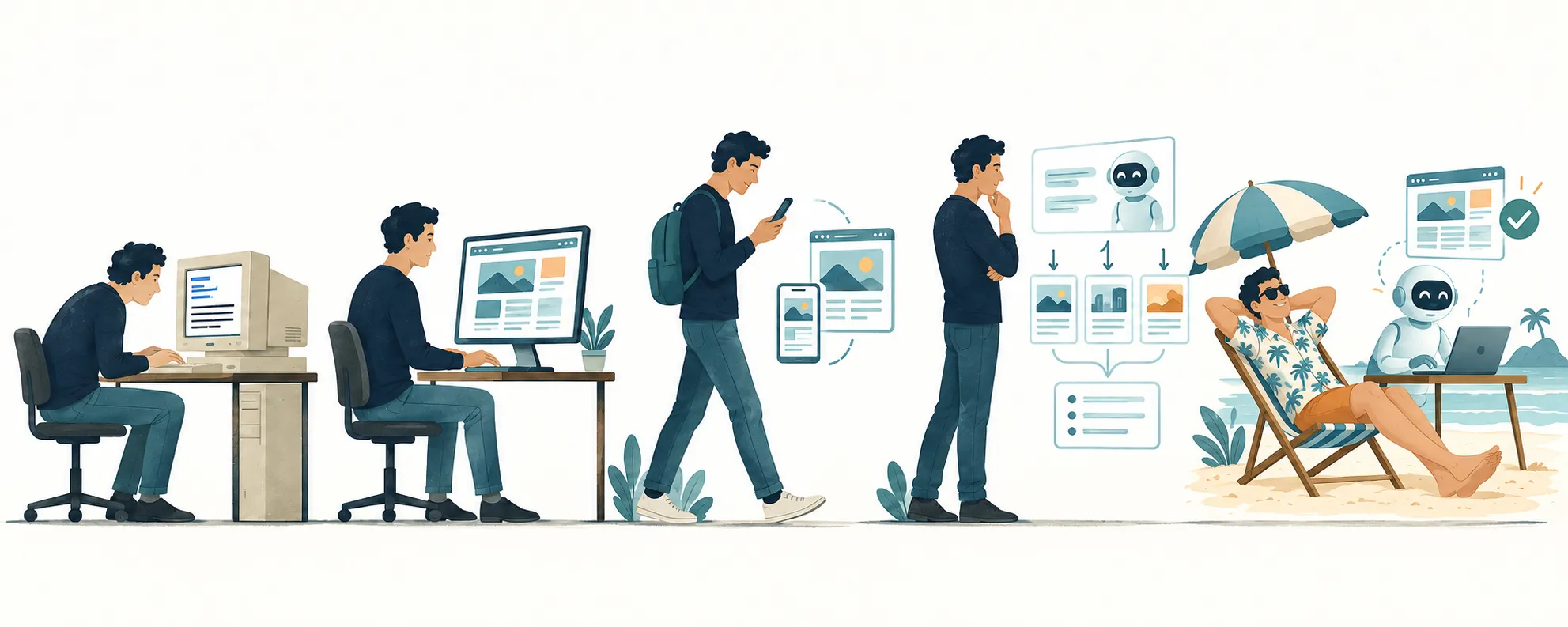
How is AI changing both sides of the website?
A customer looking for a product or service can ask an AI assistant to research the options, explain the differences and recommend a shortlist. The assistant may consult several sources and present an answer before the customer visits any of the businesses' websites.
This introduces another stage at which a business needs to be understood. Its website should make clear what it offers, who it serves, what distinguishes it and what evidence supports its claims. Recommendations still depend on the information the assistant finds and how it interprets it. Attempts to provide balanced advice do not eliminate bias, including bias inherited from promotional or affiliate sources.
On the business side, AI makes it easier to prepare articles, product descriptions, images, downloadable guides and campaign variations. A business can explore more ideas and test different messages, provided it also measures results and has enough evidence to judge what works.
But creating content is only part of the work. Someone still needs to place it on the website, format it, connect the relevant links, check the results, and publish it. If every change requires a lengthy handoff, faster content creation simply builds a larger queue.
The ability to publish and improve content needs to keep pace with the ability to create it.
One website, two very different consumers
People benefit from a visual experience. A photograph can show product quality; a diagram can explain a service; a well-designed page can make a complicated decision easier.
An AI assistant researching the same offer often needs its substance in a compact, readable form. The page's layout instructions, scripts and decorative elements can add processing work without helping it answer the customer's question.
What is Markdown, and why does it help?
Markdown is a way to structure plain text using simple symbols. A heading starts with #, for example, and a list uses dashes. It preserves useful structure such as headings, lists and links without the presentation code needed to display a designed webpage.
A website can therefore offer a visual HTML page to a browser and a Markdown representation to an AI tool that requests it.
Cloudflare already supports this approach through Markdown for Agents. In its published example, converting a page from HTML to Markdown reduced its size from 16,180 tokens to 3,150, a reduction of about 80%. Tokens are the small units of text AI models process. Fewer unnecessary tokens can leave more room for useful information and reduce processing costs. The result varies by page and workflow; some AI tools already clean HTML before sending it to a model. Cloudflare's explanation
One content source, consistent information
The visual page and the machine-readable version should come from the same source. When a service description changes, both should reflect the change through the same publishing process.
The goal is to preserve the same substantive information while changing its presentation. Prices, conditions, qualifications and important links must remain available. If a graphic contains essential information, that information also needs a useful text equivalent.
Markdown is particularly suitable for articles and service descriptions. Other information, such as product variants or live availability, may be better supplied as structured data. The wider principle is to make the information accessible in a form suited to its use.
The six requirements for the next generation of websites
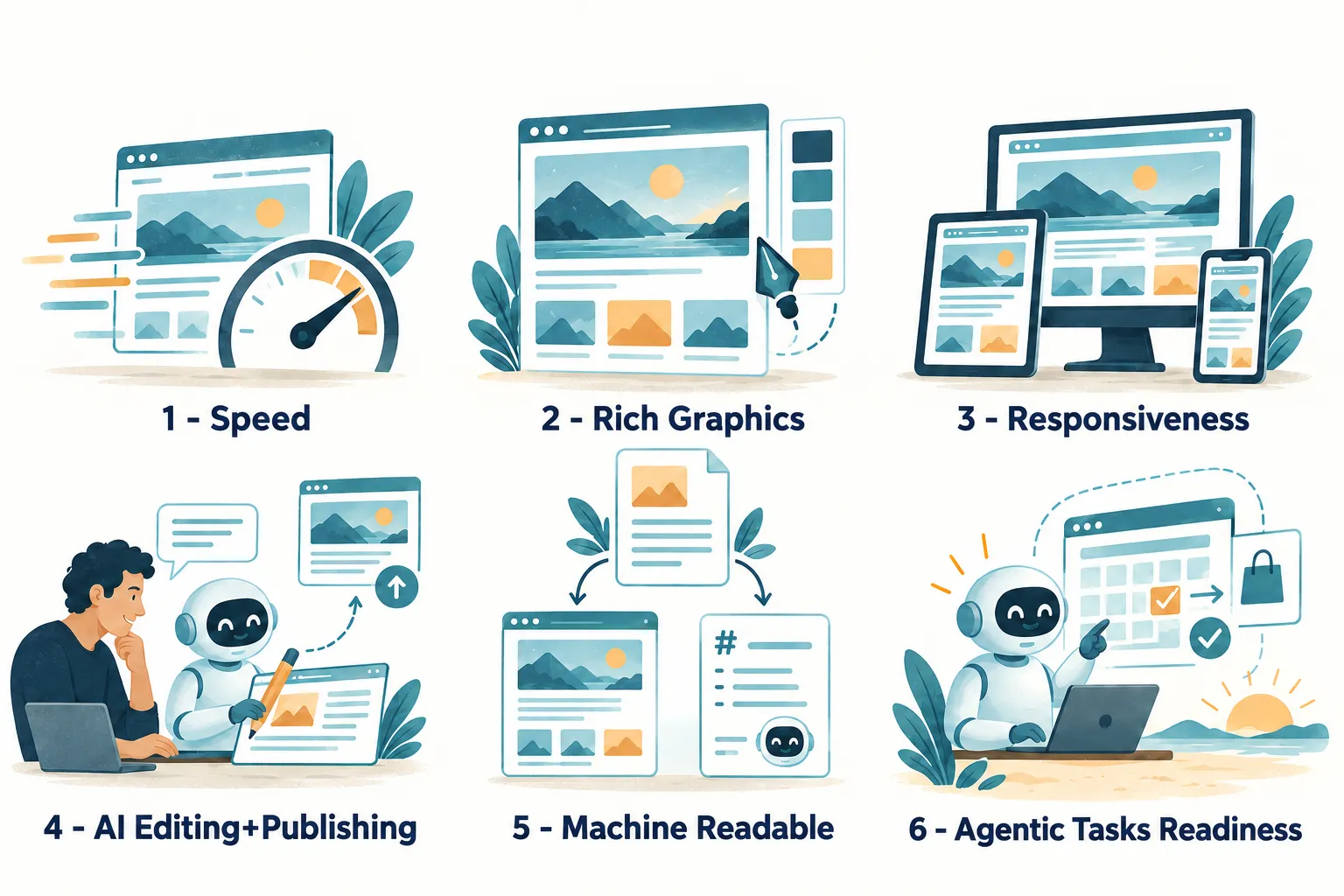
1. Fast loading and efficient access
People should be able to open and use pages quickly. AI tools should be able to retrieve their content without unnecessary processing. Lightweight pages, optimized media, and clearly accessible information support these goals.
2. Rich graphics and a clear visual identity
Photography, illustrations, video and thoughtful design remain valuable. The website should communicate the business's identity and make its offer easier to understand, while managing the loading cost of those assets.
3. Responsive design for mobile and desktop
The same content should work comfortably across screen sizes. Text, navigation, forms and images need to adapt to how people actually use the site.
4. Easy editing and rapid publishing with AI
Articles, service pages, products, categories and media should be organized so that an authorized AI assistant can help update them reliably. The path from a conversation to a reviewed, published change should be short and repeatable.
5. Equivalent content in a machine-readable format
AI tools should have access to a clean representation of the content, such as Markdown, generated from the same source as the visual page. It also needs a discoverable access path so that tools can actually request it.
6. Readiness for agents to perform tasks
Looking ahead, websites will increasingly need to support agents acting on a customer's behalf, such as booking an appointment or placing an order. This is a more complex requirement, but it is worth considering when choosing the systems the website will connect to.
Astro: a practical foundation for this approach
Astro is a framework for building websites that delivers lightweight pages and adds interactive functionality where needed. It can organize content separately from its visual presentation, supporting fast websites and flexible publishing workflows.
For content-rich business websites, that approach is particularly well suited to the requirements above.
Speed without giving up visual design
Astro can deliver most of a page as ready-to-display HTML and add JavaScript to individual features that need it, such as an interactive gallery. This helps keep the page lightweight while supporting rich layouts and responsive design. Image sizes, fonts and third-party scripts still need careful choices. Astro's architecture
Organized content that AI can help maintain
Astro's content collections can organize articles and other entries with defined fields, such as titles, descriptions and categories. Content can come from local Markdown files or connected sources. This gives a publishing assistant a predictable structure to work with, and lets templates handle the presentation consistently. Astro content collections
Web pages and Markdown from the same source
An Astro site can be configured to publish both visual pages and Markdown representations from shared content, using custom endpoints. This requires implementation: writing an article in Markdown does not automatically make a public Markdown version available. Astro endpoints
Connections to interactive features and external services
Astro can connect to commerce and other business systems. Those connections can support a human-facing storefront today and, where the connected systems allow it, agent actions in the future. Astro itself does not supply a complete commerce platform or automatically make ordering accessible to agents. Astro's commerce guidance
Together, these capabilities make Astro a strong foundation for this kind of website. Getting the full benefit requires designing the content structure, machine-readable output and publishing workflow together.
Easy editing and rapid publishing with AI
Consider a business owner who wants to add a new service. They discuss the audience, offer and wording with an AI assistant, then refine the draft. With the right setup, that conversation can continue into updating the actual website.
Desktop AI tools with access to project files and publishing tools, such as Codex, can support this workflow. A website project gives the assistant access to the relevant working files. Project instructions can explain the site's structure, writing style, languages and publishing process. The necessary connections and permissions must also be configured; a chat conversation by itself does not provide publishing access.
Skills provide reusable instructions for a particular task, optionally accompanied by templates or scripts. A website publishing skill could explain where to save an article, which fields it needs, how to prepare its language versions and how to check the result. OpenAI's documentation on skills
A practical workflow could look like this:
- Discuss the idea and draft the content with AI.
- Ask it to prepare the website files using the existing templates and publishing instructions.
- Review a preview, including links, images and mobile layout, and request any changes.
- Publish the approved version through the pre-configured process.
Once that process is established, routine updates can involve much less manual copying, formatting and coordination. The owner focuses on the message and the result, while the assistant carries out the implementation steps.
This also changes what a development team delivers. Alongside a working website, it can provide a practical way for the business to keep improving it.
From reading websites to acting on them
The next step extends beyond content. A customer may ask an assistant to find an available service and book it, or compare products and complete a purchase. Supporting these tasks involves the systems behind the website, including permissions and reliable confirmation of results.
That deserves a separate discussion. For website planning today, the relevant point is to choose a foundation that can connect to those systems as the need develops.
What should website owners prioritize now?
Start with a routine change your business already makes: adding an article, revising a service or updating a product. Follow it from the initial idea to publication and identify where time is lost. This gives you a concrete starting point for an AI-assisted publishing workflow.
Then examine the information customers need. Can people find it easily? Can an AI tool retrieve and interpret it? Can you provide a clean version from the same content source, keeping both representations current?
When planning a new website or a substantial upgrade, include these questions in the brief. Ask the development team to demonstrate how a real update would work, how the content would be available to AI and how the site could connect to future services.
The website's value increasingly depends on how well it serves people, how efficiently its information can be used and how readily the business can improve it. Build those abilities into the foundation.